NATA Space
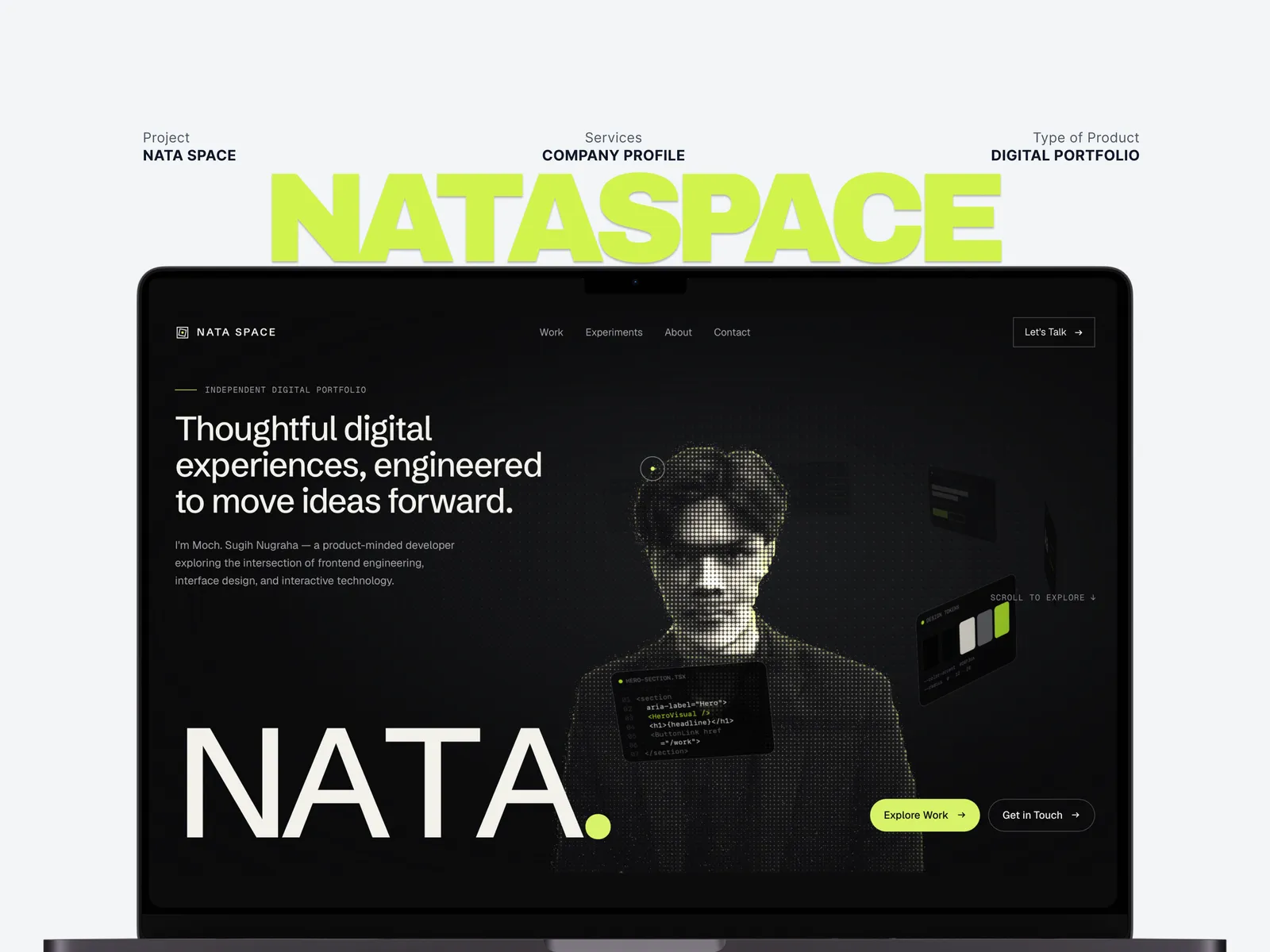
The site you are on: an art-directed portfolio with a procedural 3D hero, a typed content system and progressive enhancement throughout.
- Interactive portfolio · Creative technology
- Design & engineering — solo, independent project
- Live
- 2026
01Context & problem
A personal portfolio has two jobs: explain quickly who is behind the work, and demonstrate the craft it describes. NATA Space is the portfolio and creative-technology showcase under the wider NATA identity.
Deliver a memorable, immersive first impression with real-time 3D without letting that spectacle block reading, navigation, accessibility or performance on average mobile hardware.
02Constraints & goals
- Main content and calls to action must render before — and without — WebGL.
- Respect prefers-reduced-motion and touch devices.
- No invented clients, metrics or testimonials; unapproved work stays in draft.
- No downloaded 3D assets: geometry is procedural to keep payload small.
03My role & contribution
Design & engineering — solo, independent project
- Brand system, typography scale and design tokens
- Information architecture and route map
- Next.js App Router implementation with Server Components by default
- Procedural Three.js / React Three Fiber “Spatial Core” scene
- Accessibility, reduced-motion and WebGL fallback strategy
04Approach & decisions
Content first, 3D second
The hero headline, introduction and buttons are server-rendered HTML. A static SVG poster of the sculpture sits underneath; the WebGL scene is dynamically imported on the client and fades in only once it is ready.
A sculpture, not an orb
The Spatial Core is an architectural composition — a monolith, a twisted stack of square frames, tilted orbital paths and five nodes mirroring the working process. Pointer movement is damped and clamped so it never feels unstable.
Capability-aware rendering
Device pixel ratio is capped, mobile receives a lighter scene, reduced-motion renders a still frame, and the render loop pauses when the canvas leaves the viewport. Context loss falls back to the poster.
Typed, filtered content
Projects are typed records with a publication status. Public pages, case-study routes and the sitemap all read through one filter, so drafts and private work cannot leak.
05Gallery
NATA Space — digital portfolio, live hero. Design tokens — one accent, three type roles. Rendering layers — content never waits for WebGL. Spatial Core composition — procedural, no downloaded model.
06Engineering notes
- Server Components by default; client code is limited to the header, motion helpers, galleries and the 3D island.
- Three.js is only requested on routes that render a scene.
- GSAP ScrollTrigger is used for two restrained sequences and disabled under reduced motion.
07Outcome & learnings
Shipped as the v1 MVP of NATA Space. Performance is measured against the production build rather than asserted; no audience or business metrics are claimed.
Treating the 3D layer as progressive enhancement made every fallback state a first-class design, not an afterthought.
A single publication filter is simpler to trust than per-page checks.